Wednesday, September 12, 2012

Senior Air India pilot shows up for flight with expired licence

Mumbai: Last week, Air India had come under fire from the Directorate General of Civil Aviation ( DGCA) as it let a commander who held an expired pilot license operate a flight. Air India's general manager (flight operations), Capt N K Beri, evidently did not learn any lessons from the incident.
On Saturday, Capt Beri, also a Boeing 747 commander, flew as a passenger from Delhi to Kozhikode to operate AI's Kozhikode-Jeddah flight, only to realize on landing in Kerala that his pilot license had long expired and he had forgotten to renew it. The airline had to scamper for a replacement and the flight departed 15 hours behind schedule. AI GM Capt Beri's callousness added to the ailing airline's expenses as it had to provide food and accommodation to passengers as the Saturday evening flight AI 963 departed only on Sunday morning.
11/09/12 Manu V/Times of India

Sunday, August 12, 2012

Jet aircraft skids off apron area as maintenance staff lose control

New Delhi: A Boeing 737 aircraft of Jet Konnect skidded off the apron area at the IGI airport here as the maintenance staff lost control of the aircraft while taxiing it from hanger but no one was injured in the mishap.
The incident happened around 10.30 PM last night. After four-and-a-half-hours, the aircraft was finally pushed back to the hangar with the help of tow tractor, sources said, adding airport operations were not affected and quick action by airport personnel avoided any damage to the aircraft.
The Jet Airways maintenance staff are said to have lost control of the steering and the brakes due which the plane skidded off the tarmac and its nosewheel crossed a drain beside the apron near the fire station four of the airport, they said.

10/08/12 PTI/Business Standard

Sunday, July 22, 2012

Planes to soon have onboard system to scare birds

New Delhi: With bird strikes costing the aviation industry millions of dollars, plane manufacturers are now working on a system that will be installed in the aircraft to scare off the avians.
Aircraft manufacturer Airbus is developing a system under its Bird Impact Repellent and Deterrent sYstem (BIRDY) programme that will scare away almost every species of birds.
"Challenge is to develop a system that is effective for large number of species of birds found across the globe," Nathalie Papin, an expert with Airbus Industries, said here.
According to estimates, airlines in the US suffer loss of USD 68.3 million per year while worldwide the carriers have lost USD 1.3 billion in direct damage and associated costs in terms of aircraft down-time.
In India, airlines have lost about Rs 18 crore in 2011 due to bird-hits and incidents of runway incursions by stray animals.
22/07/12 ZeeNews

Wednesday, July 4, 2012

E.K.Bharat Bhusan gets extension as DG Civil Aviation

The Appointments Committee of the Cabinet has approved the extension of additional charge of the post of Director General, Directorate General of Civil Aviation to Shri E.K.Bharat Bhusan for a further period of one year with effect from 01.12.2011 or till the appointment of a regular incumbent, whichever is earlier with the direction to the Ministry to fill up the post within this period. Shri Bhusan is Additional Secretary and Financial Adviser in the Ministry of Civil Aviation. The Cabinet has observed that the appointment of a regular person to the post of DG, Civil Aviation has been held up for too long a period of time and that this post should be filled up without loss of any further time.
03/07/12 Press Information Bureau

Kingfisher endgame: Mallya’s hold is now almost zero

Should we be calling Vijay Mallya the owner of sinking Kingfisher Airlines anymore? Consider the evidence to the contrary.
With debt of over Rs 7,500 crore, Mallya has pledged nearly 95 percent of his shareholdings in the airline to lenders. According to Business Standard, the total current market value of Kingfisher is Rs 960 crore, but Mallya owns only Rs 30 crore worth of shares that are unencumbered. This means his lenders are the real owners of the airline.
But now even the lenders are bailing out. On Monday, ICICI Bank announced that it had dumped its entire Rs 430 crore loans to Kingfisher in favour of Srei Infrastructure Finance at par – along with the collateral. The bank, which held 5.68 percent of Kingfisher’s shares through loan conversions, now holds about 3 percent. Other bank lenders apparently own around 21 percent. They may also be in a mood to bail out like ICICI Bank.
03/07/12 First Post.com

Saturday, June 30, 2012

Even a hangover can ground pilots: DGCA

New Delhi: Pilots beware! Even a hangover can ground you.
Tightening 'drinking and flying' rules, aviation regulator DGCA has warned that a pilot's licence can be suspended for five years when detected for a second time.
On the first occasion, he would be kept off duty and licence suspended for three months.
"Should an emergency occur, the crew who has alcohol in his system is just that much less capable of dealing with the problem," the Civil Aviation Requirement (CAR) on the issue, which was recently revised by the Directorate General of Civil Aviation (DGCA), said.
The DGCA said that studies had found that even when the blood alcohol levels were zero, there could be some effects of hangover which are due to congeners, which take 15 to 18 hours to dissipate. A hangover could be there for upto 36 hours.
29/06/12 PTI/Daily News & Analysis

Wednesday, February 15, 2012

Jet Airways suspends pilot for allowing trainee to be co-pilot

New Delhi: Jet Airways had suspended the pilot of one of its flights and another cockpit crew for two and half months for allowing a trainee pilot to take over from co-pilot to land the plane in Mumbai, endangering all those onboard. 

Aviation regulator DGCA had asked the Jet to take action against the pilot and the chief of its flight safety in connection with the incident that had taken place about four months ago, official sources said.
A Jet Airways spokesperson said the action against the pilot and another member of the cockpit crew was taken based on "appropriate investigations and a confidential report".
The commander, who had asked the co-pilot to make way for the trainee pilot on board, was suspended for two and half months. However, he resumed flying after serving out his suspension period.
14/02/12 PTI/Economic Times

Tuesday, December 13, 2011

Jet and Kingfisher's Return Flight


mg_61262_aviation_leader_280x210.jpg
Jet and Kingfisher's Return Flight
Kingfisher and Jet Airways are betting on two different strategies to come out of the deep financial mess they have found themselves in
Since May 8 this year, a curious new bird has been flying on Indian skies. Maverick businessman Naresh Goyal has sprung a surprise by launching a new low-fare flying service, Jet Airways Konnect, by taking away half the number of flights from his flagship brand, Jet Airways. And he has done something normally unthinkable — he has ripped out the business class and replaced it with economy class seats. Then, in a complete break with his business philosophy, he made Jet Konnect a low-cost carrier (LCC), setting prices that compete with the likes of SpiceJet and Indigo.

– Disconnect with J Class, Forbes India, June 2009

-------------------------------------------------------------------------------------------------------------
Almost two-and-a-half years have passed since Naresh Goyal swallowed his pride and launched Jet Konnect, his answer to the low-cost challengers who were threatening to change the ground rules in Indian aviation. In many ways, Jet Konnect turned out to be quite a phenomenon. Even today, it accounts for 70 percent of all the seats that Jet Airways sells in the domestic market. Along with JetLite, it’s roughly twice the number of low-fare seats of Indigo and SpiceJet combined.

Based on these statistics alone, you’d imagine Naresh Goyal would be in clover. Instead, here’s the paradox: If insiders are to be believed, Goyal is almost about to abandon his Jet Konnect service and reboot operations completely. The trigger: Jet reported losses of Rs. 838 crore between April and September 2011.  That’s not all. The airline has also made significant losses in three of the last four years. Debt is already piling up. The situation is so alarming that the canny entrepreneur has begun to look at every strategic option on the table. One thing is now amply clear: His Jet Konnect strategy may have helped him hold market share at 28 percent for a while, but it failed to make long-term business sense. And neither did JetLite, yet another low fare offering, built from the ashes of the erstwhile Sahara. Neither service had the operational efficiencies of a low-cost carrier like Indigo, nor was their cost structure low enough to allow it to sustain a low-fare strategy.

The realisation has dawned that Jet Konnect was no different from Jet’s full service offering (with all its attendant costs) minus the meals. Two weeks ago, the top management at Jet met to explore the possibility of adopting a two-tiered strategy: A full-service airline aimed at premium business travellers and a newly branded low-cost airline with a completely separate management team and a larger national footprint. There’s still no confirmation yet on whether Goyal has given the plan the go-ahead. “It is like trying to unravel a plate full of spaghetti,” admits a senior executive from Jet, on conditions of anonymity.
mg_61212_rahul_bhatia_280x210.jpg

Even as Goyal figures a way to get out of the classic stuck-in-the-middle syndrome, Vijay Mallya, his bitter rival, has his task cut out in his bid to save his airline. He too has much the same dilemma: The dual strategy of running Kingfisher Red, a low-fare airline, along with his full-service airline Kingfisher has completely backfired. With debts of Rs. 7,500 crore and accumulated losses of Rs. 4,500 crore, Mallya is barely able to meet solvency norms. Like Goyal, his team led by CEO Sanjay Aggarwal is making a desperate attempt to adopt a whole new radical game plan. “We’ve looked at both options: To become full-service and low-cost. We believe there are simply too many players who’ve taken positions in the low cost space. We’ve therefore opted to play the game the best way that we know: Remain focussed on the full-service model,” says Aggarwal.

Given the size of Kingfisher’s debts, there aren’t too many folks who’d pay much heed to this strategy just yet. So first, Mallya has to find fresh capital quickly — and time is running out. But even if he continues his search for suitors, a significant part of his revival plan depends squarely on whether his new bet on an entirely full-service model is able to win back the patronage of his business travellers at a fare that’s at a reasonable premium over the low-cost players.

So here’s the tricky question: Who has the best chance to emerge out of the rut? Much like everything in life, there aren’t any simple answers. So belt up, and let’s hit the road to understand the delicate survival plan that two of Indian aviation’s best-known entrepreneurs are plotting.

Thursday, November 10, 2011

Kingfisher cancels more flights, gets notice

Air passengers all over the country faced tough time as cash-strapped Kingfisher Airlines cancelled more than 30 flights on Wednesday. The airlines said that it was cancelling 50 flights everyday from Wednesday. According to reports, the airline would give details of cancellations to take place in the coming weeks. Lot of passengers were stuck due to the cancellation of the flights and many others had to book tickets in other airlines at higher prices.
The Directorate General of Civil Aviation  has sent Kingfisher a notice over the sudden cancellations. The DGCA has sought a reply by Thursday. 

Last month Kingfisher Airlines (KFA) promoter Vijay Mallya met senior government officials in both the finance and civil aviation ministries to present details about the precarious state of private airlines’ balance sheet, showing how losses will only multiply unless fares are hiked, a government source told HT requesting anonymity.
He had also sought a level playing field, arguing that state-owned Air India enjoys many advantages as it can dig into the government’s coffers to fund its way out of a crisis, an option not available to its private-sector peers.
"He has argued for an immediate need to hike fares to prevent a halt in operations," a government source said.
Mallya’s calling on the ministers came barely 10 days after he announced that KFA will shut down its low-cost arm Kingfisher Red in the next four months.
The capital-starved airline has not made profits since its inception in 2005, had a debt of Rs 7,057.08 crore as on March 31, 2011 and reported a loss of Rs 1,027 crore for 2010-11.
It has been defaulting on payments to oil companies and airports, and had delayed salaries to its employees for August and September.
May have to compensate passengers
Aviation regulator Directorate General of Civil Aviation (DGCA) said the airline may have to compensate passengers for these cancellations, over and above normal refunds.
Funds are only one of the myriad problems confronting KFA.
High interest liability, vendor payment schedules and inability to meet daily jet fuel payment commitments are making turnaround difficult.
KFA’s tanking scrip has hurt banks. A consortium of 13 lenders led by the State Bank of India and ICICI Bank had picked up a 23.2 % stake in the airline in March, of which SBI and ICICI hold 5.7% and 5.3% respectively.
In seven months, the stock price has fallen nearly 67% to 21.70 on Wednesday.

Thursday, October 20, 2011

Finally, intra-Gujarat flights take wing

AHMEDABAD: Come Christmas, honchos wanting fly across Gujarat will get wings. SpiceJet will start operating intra-state flights connecting Ahmedabad and Surat with Saurashtra and Kutch. The launch is being timed with Rannotsav, the annual desert festival organised by the state government in Kutch. The Tourism Corporation of Gujarat Ltd has approved the project.

The company plans to fly 78-seater, Q400 aircraft. Functional airports in Ahmedabad, Surat, Porbandar, Bhuj, Jamnagar, Keshod, Rajkot, Bhavnagar and Vadodara will be linked gradually. Ahmedabad and Surat will be made the hubs, connecting other centres. The company may fix a basic fare for a one-hour flight at Rs 2,400. Kamal Hingorani, vicepresident, SpiceJet said, "We have acquired 30 aircraft exclusively for connecting Tier II and Tier III cities across the country. Gujarat is an important market."

According to him, the airlines has started intra-state operations in Andhra Pradesh. The planes are running at 85 per cent occupancy. He further said that the basic fare cost for a one-hour flight was around Rs 2,400. Earlier, Deccan Charters Ltd, Luan Airways and Ventura Airlines had announced daily flights connecting important destinations in Gujarat. However, the plans have not yet materialisedDCL's plan hit a roadblock when the Director General of Civil Aviation did not approve of the lease agreement under which the company had sought to procure three 60-seater aircraft from Denmark.

Friday, September 9, 2011

AI move to acquire 111 planes a recipe for disaster: CAG

The decision to acquire 111 planes by Air India through debt was "a recipe for disaster" and should have raised alarm in the government, the Comptroller and Auditor General (CAG) has said.
Terming the move for getting of a "large number" of planes as "risky", the CAG said the aircraft acquisition had "contributed predominantly" to the airline's massive debt liability of Rs 38,423 crore as on March 31 last year.
In its latest report tabled in Parliament today, the public audit body also called the merger of two erstwhile state-run carriers - Air India and Indian Airlines "ill-timed" and said that "the financial case for the merger was not adequately validated prior to the merger".
"The entire acquisition (for both Air India and Indian Airlines) was to be funded through debt (to be repaid through revenue generation), except for a relatively small equity infusion of Rs 325 crore for Indian Airlines.
"This was a recipe for disaster ab initio and should have raised alarm signals in Ministry of Civil Aviation, Public Investment Board and the Planning Commission", the report said.Significantly, the CAG recommended, among other measures, "a total hands-off approach (by the government) with regard to the management of the airline".
The report dealt with several aspects of the ailing national carrier's losses, fleet acquisition, merger, huge debt burden, delay in joining the global airline grouping Star Alliance and its financial and operational performance.
08/09/11 PTI/Moneycontrol.com

Tuesday, September 6, 2011

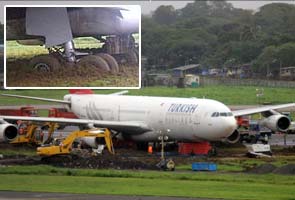
Mumbai Airport's main runway re-opens after four days

Mumbai: The main runway of the Mumbai International Airport was re-opened on Monday after four days. The runway was shut for four days after a Turkish Airlines flight had veered off the runway and got stuck in the mud near the runway.
Airport authorities said that the Turkish Airlines flight was removed at 1.17 a.m. on Monday and the runway was re-opened at 6.51a.m.
A combined team of engineers from Larsen & Toubro, Mumbai International Airport Ltd (MIAL), Air India as well as Turkish Airlines were working together with 200 labourers in shifts since Friday to tow away the aircraft.The aircraft was taken to the Air India hangar for repairs.
05/09/11 Business Line

Saturday, September 3, 2011

Capt Gopinath to sell Deccan 360

Bangalore/Mumbai: A final effort is on to salvage whatever little is left of Deccan 360, the air & ground cargo service launched by low-cost aviation pioneer G R Gopinath. Discussions have been initiated to sell the company to a Mumbai-headquartered, highly diversified, multi-billion dollar corporate group which has interests in retail and logistics, among various others.
Since early May, Deccan 360 had stopped its services because the volumes did not pick up to service the lease for the three Airbus 310s. The aircraft has since been taken back by the lessors.
Deccan 360 now has only two ATRs, which is grounded as the company is not taking any orders. Close to 1,000 employees have been asked to look-out for jobs and the majority have left the company in the past couple of months.
Deccan 360, launched during May 2009, had raised Rs 115 crore equity investment from Reliance Industries early last year, with a commitment to invest further as the operations expand. With operations of Deccan 360 not going according to plans, RIL stopped investments and is understood to have expressed willingness to exit or pare down its stake.
According to investment bankers close to RIL, Reliance Industries has since structured a transaction to move its investment in Deccan 360 to RIL’s CMD Mukesh Ambani’s personal investment portfolio.
Ever since May 2011, Capt Gopinath has been trying in vain to raise resources from various private equity funds and other global players to raise fresh investment through companies which would buyout RIL’s stake and invest further to take the operations further.
The search seems to have led him to the large corporate house and talks are understood to have progressed well.
02/09/11 Raghuvir Badrinath & Arijit Barman/Business Standard

Monday, August 29, 2011

Gulf Air plane skids off runway in India (Kochi), 137 passengers narrowly escape


Saudi Arabian flight cancelled, several services diverted

KOCHI, Kerala: Gulf Air flight GF 270, carrying 137 passengers from Bahrain who were mostly overseas Indian workers, had a narrow escape Monday as it skidded off the runway and came to a halt in muddy areas some 30 meters away, damaging its nose wheel.
Seven of the passengers have sustained injuries, one of them admitted to hospital with fractures, as they tried to jump to safety through the emergency exits of the Airbus 320 aircraft amidst confusion. Some of them lost their passports and other documents in the marshland. The passengers included an infant.
Officials at the Cochin International Airport Limited (CIAL) said bad weather could be the reason for the mishap. The plane stopped before hitting a wall, averting a major tragedy, reports said. Most of the passengers were from Saudi Arabia and the neighboring emirate of Bahrain.
A Saudi Arabian Airline flight (SV 778, bound for Jeddah via Riyadh) and 11 domestic flights were canceled following the accident while several flights were delayed or diverted to nearby airports of Thiruvananthapuram, Calicut in Kerala and Bangalore in nearby Karnataka state.
The diverted flights include Etihad EY 280 (Abu Dhabi), KU 351 Kuwait Airways (Kuwait), AI 934 Air India (Sharjah), IX 434 Air India Express (Dubai), 9W 561 Jet Airways (Sharjah), 9W 555 Jet Airways (Doha) and QR 266 Qatar Airways (Doha). Air India Express' IX 452 bound for Abu Dhabi was rescheduled.
The Etihad, Kuwait and two Jet Airways flights from Sharjah and Muscat were diverted to Trivandrum, while an Oman-Cochin flight was sent to Bangalore. Passengers were brought by road to Cochin from Trivandrum.
Last year, an Air India flight from Dubai skidded off the tabletop runway of the Mangalore airport, some 400 km from here, fell over a cliff and caught fire, killing all but eight of the 166 passengers and crew members.
Initially it appeared like a copycat landing. However, Cochin has a normal runway with a length of 3400 meters, which is believed to have helped safe landing. There was a heavy rush of vacationing workers ahead of the festival season of Eid Al-Fitr and Onam, the southernmost state's harvest festival.
West Asia is home to some two million guest workers from Kerala and they mainly depend on the three international airports in the state as well as Mangalore in the neighboring Karnataka state.
The accident occurred at 3.55 am Indian time and the runway was immediately closed. It became partially operational by the afternoon after a Disabled Aircraft Retrieval Kit arrived from Mumbai. CIAL runs India's first corporate airport funded mainly by its diaspora.
The Director General of Civil Aviation (DGCA) EK Bharat Bhushan, who ordered an enquiry into the incident, said it was too early to say anything about what could have led to the accident.
"An inquiry team from Chennai has reached the airport and they are looking into it," Bhushan told a local television channel. They will inspect if there's any breach of protocol while landing and if it could have been averted. The airport was immediately closed for traffic.
The CIAL Managing Director VJ Kurien said the airport authorities were hopeful that the services at the airport would be normalized by midnight. There was no damage to the runway though there was heavy rain since last night which continued as the plane was landing.
"There was visibility till 2,000 meters (when the permission was given for landing)," Kurien told reporters. "We've been told by the pilot that the main reason has been there was heavy rain when he had gone beyond the decision-making height of 352 ft. At 2,000 meters, it was moderate rain but there was a sudden gush of rain before the touchdown."
The pilot was quoted as saying the aircraft veered off the runway because of the heavy rain and poor visibility. The wings, nose wheel and engine have been damaged. The instrument landing system, on the other hand, was perfect.
A special aircraft was on its way from Mumbai to remove the damaged aircraft. "Two cranes have already arrived and a bigger crane is coming from the Cochin Shipyard. We have also got wooden sleepers from the railways," Kurian said.
The airport has been closed for operations for the time being. According to Kurian, the plane is now lying 31 meters away from the runway.
"At the moment, 2,050 meters of runway has been cleared. Right now, small aircraft can land. Only by midnight would the entire 3,100-meter runway be cleared and full operations resume.
"Twelve flights have been delayed, including three international flights which were supposed to take off after the landing of this Gulf Air flight. Four incoming international flights have been diverted to Thiruvananthapuram and another one to Bangalore," Kurian said.
He said the airport officials had cleared about 2,050 meters of runway which would enable small and medium-sized aircraft to operate. An Oman Air flight landed at the airport at around noon. The runway needed at least 3,100 meters to operate for bigger aircraft like 737s.
The ill-fated aircraft was lying 31 meters right to the central line. The exact position of the flight right now is 2,300 meters south of 09 westerly approach. Except for one passenger, airport officials could complete the checkout formalities within 55 minutes after the incident, according to Kurian.
"Our first priority was safe evacuation of passengers, and providing treatment to those injured. Within about 50 minutes we were able to send out all the uninjured passengers, with their luggage, and after completing the immigration procedures. We will take steps to complete the immigration procedures for the injured passenger at the hospital,'' he said.
The runway was partially opened for traffic by 8 a.m. for ATR aircraft and A-320s and Boeing 737s by about 10 a.m. It is expected to be fully operational by late in the night. Injured passenger V. Syed Mohammed of Palakkad told reporters from his hospital bed that he suffered injuries when he jumped out of the aircraft in panic.
SpiceJet receives first Q400 aircraft from Bombardier

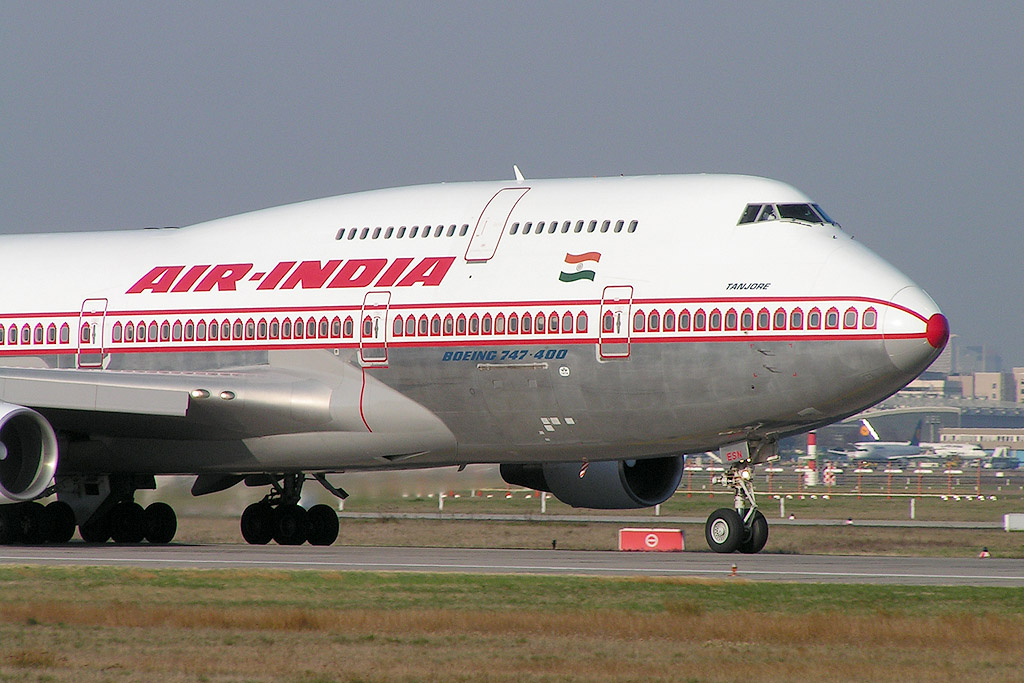
Saunf and Tulsi are airborne and on their way to India; Heeng and a dozen others, including Mirchi, Elaichi and Tejpatta would follow in the coming weeks and months. This potpourri is low-cost airline SpiceJet's new Bombardier Q400 NextGen turboprop fleet. All 15 aircraft would bear the names of Indian spices.
SpiceJet plans to use these aircraft to provide cheaper aviation opportunities in India’s fast-growing smaller cities and towns.
Bombardier Senior Vice-president (sales and marketing), Chet Fuller, handed over a ceremonial key of the new aircraft to SpiceJet Chairman Kalanithi Maran, his wife, and Chief Executive Officer Neil Mills at the Canadian aerospace company’s facility near Toronto on Friday. A few minutes later, Saunf took off, with a crew of three pilots and an engineer. A similar team is flying Tulsi back home. As the aircraft is a short-haul plane, the flight would have a number of touchdowns – in Goose Bay, Canada; Reykjavik, Iceland; Bournemouth, UK; Valletta, Malta; Luxor, Egypt; and Muscat, Oman before reaching New Delhi on August 30.
SpiceJet would use the turboprops in its new regional service scheduled to start on September 21. While Maran didn't answer any questions, he said the new aircraft “will totally change the lives of people in Tier-II and Tier-III cities in India by making flying more affordable”. He also said the Smart Parts agreement between Bombardier and SpiceJet was evidence that the airline planned to be a long-term operator of the aircraft.
Mills said initial bookings for the Q400 flights were “encouraging”. Speaking to Business Standard, he said the delivery of the first batch of aircraft had been delayed, as SpiceJet was awaiting regulatory approvals in India for financing the deal. The $450-million order is being financed by Canada’s export credit agency, Export Development Canada (EDC). “Getting approvals in India is a long, uncertain and challenging process,” said Mills, adding EDC had been very “patient and understanding”.
Under the deal, SpiceJet also has the option of ordering 15 more Q400 NextGen aircraft. Mills said over the next six months, the airline would decide whether to exercise the option after tracking the performance of the aircraft on their regional routes. He said the decision would be based more on the actual performance of the planes, rather than the business generated on the routes in the short term.
Each turboprop would fly over 11 hours every day on flights not exceeding two hours. “We will fly them hard,” said Mills, “That’s the whole point of these aircraft.” Bombardier officials say the speed of their turboprops can be compared to to regional jets, enabling operators to get more flying hours per day out of their fleet.
A tour of Bombardier’s facility near Toronto revealed a number of SpiceJet’s Q400 NextGens in various stages of construction, testing and inspection. Besides the first two that were handed over on Friday, two more would be delivered on Wednesday. SpiceJet expects to receive 11 aircraft by next March, with the order to be completed by July. The fleet would also mark Bombardier’s mainstream debut in India’s rapidly-growing market.
Indira Kannan / Toronto August 28, 2011

Friday, August 26, 2011

AI rethink on free tickets to employees


New Delhi: The government has formed a committee to look into Air India’s policy of giving tickets free or at a concession to certain categories of employees.
“In Air India, concessions are given even to distant family members of employees. We have to revisit several such issues. A committee has been appointed to look into the issue,” said V. Narayanasamy, minister of state in the PMO. The government will take appropriate steps after the committee submits its report.
“Air India offers free tickets to organisations and associations as part of advertising and sales promotion and also to individuals for claims arising out of complaints. All employees of Air India, including retired employees and their families, are also eligible for free and concessional passes of varying terms,” he said.
These tickets are offered under approved schemes. So, no revenue has been foregone. But in view of the mounting losses, Air India may relook the policy based on the recommendations of the committee, Narayanasamy said.
The airline’s accumulated debt of Rs 42,570 crore means the government needs to inject over Rs 6,500 crore annually just to keep the company in business.
25/08/11 Telegraph

Thursday, August 18, 2011

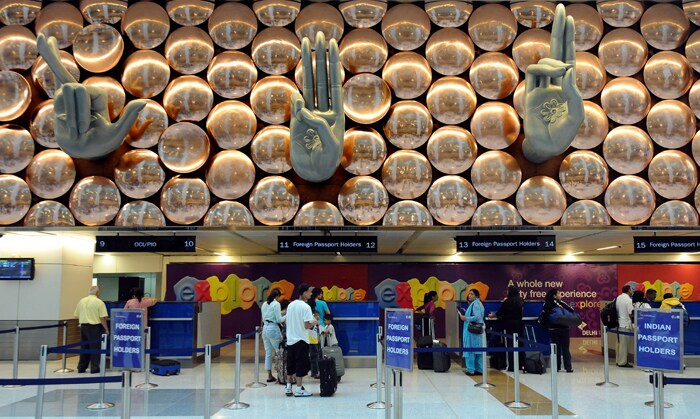
T3 to remain India's largest for 8 yrs

New Delhi: The Terminal 3 (T3) of the Delhi airport, the largest in the country, which completed one year of operation last month, will continue to carry the largest tag for about eight years, as the operator does not see the need for expansion of the airport.
“We will not have to go for expansion for at least five to eight years, as the existing capacity will be able to match passenger growth,” said a GMR spokesperson, who did not want to be identified.
The Delhi airport is operated by Delhi International Airport Ltd, a joint venture company led by the GMR Group, along with state-owned Airports Authority of India, Germany’s Fraport and Malaysian Airport Holdings.
Currently, the airport has a capacity of handling 60 million passengers annually. It can be raised to 100 million by building two more terminals in phases.
T3, which alone can handle 34 million passengers a year, is the eighth-largest passenger terminal in the world in terms of size. The Delhi airport shot into limelight after the inauguration of T3 by Prime Minister Manmohan Singh in July 2010.
In 2007, the GMR-led consortium had bagged the contract for T3. The launch of T3, coupled with improved service after being taken over by a private operator, has made the Delhi airport the fourth best in the world in the category of annual passenger handling between 25 and 40 million.
15/08/11 Mihir Mishra/Business Standard

Sunday, August 7, 2011

CAG says AI lost Rs 5,000 crore in bad deals

NEW DELHI: Air India was delivered a double whammy by UPA-I, it has come to light.

An RTI reply from the government has revealed that Arvind Jadhav, who was made chairman of AI in 2009 just before the last general election, had been rejected for the position a year ago as he did not have any experience in aviation.

But UPA-I mysteriously chose to replace Raghu Menon with Jadhav at a time when the election code of conduct was in place. Menon had steadfastly refused to sign a controversial ground handling deal with a foreign company and had asked for a one- or two-year ban on giving any more flying rights to Gulf and South East Asian carriers to avoid revenue loss to AI.

The Comptroller and Auditor General (CAG) has found that AI and erstwhile Indian Airlines lost close to Rs 2,000 crore in the 111 aircraft deal struck for them during UPA-I through faulty purchase and bridge loan deals and also avoidable expenses incurred by delay in returning leased planes once new ones started joining the fleet.

The figure of total aircraft acquisition-related losses could have been closer to Rs 5,000 crore as the CAG found that erstwhile IA opted for costlier loans for buying 21 Airbus aircraft leading to a loss of Rs 315 crore till last March.

"A loss of Rs 2,459.79 crore would further be incurred in future... (due to) faulty finances," the audit observation under the head of "funding of the project" says. However, the airline gave a lengthy reply justifying the taking of loans from banks which the aviation ministry claims was found satisfactory by CAG and may be dropped from the final report.

The CAG's performance audit on aircraft acquisition has blasted the decision to acquire so many planes in one go. "Capacity expansion was not based on due diligence. While replacement of (old) aircraft.. is understandable, the proposal to expand capacity was not warranted in view of intense competition and the inability of Indian Airlines Ltd to handle competition with its poor financial performance... It should have opted to procure aircraft in two phases," the report says for erstwhile IA. It also questions government decision to order 50 planes for AI instead of placing firm orders for 35 along with an option for 15 more.

The report says AI-IA lost Rs 200 crore due to "defective contract terms relating to escalation payments" under the heading of placement of orders. It is found to have lost a similar amount by availing bridge loans at higher interest rates.

While its market share and aircraft occupancies have been constantly falling, AI could not even return the old leased planes in time when the new ones started joining the fleet. "Indian Airlines Ltd extended the lease period for 28 aircraft as well as entered into fresh lease agreements for 12 aircraft. As a result, IAL incurred substantial expenditure of Rs 972.54 crore. These leases would further cause an avoidable outgo of Rs 721.60 crore... The company did not identify the routes/sectors on which the additional capacity... was to be deployed," the report says, adding that IA introduced only 12 new links till November 2009 despite getting 34 new planes.

The management has replied to each of these observations, but has now itself come under a cloud. On Saturday, BJP leader Rajiv Pratap Rudy blasted UPA-1's controversial decision to hoist Jadhav as CMD. He pointed out that a search committee to select AI CMD met in March, 2008. A confidential note signed by people like the then cabinet and aviation secretaries and principal secretary to PM (T K A Nair) released under RTI says that the panel wanted someone with experience in aviation due to the "complex administrative issues in areas of personnel and finance management arising out of the merger of AI and IA."

Then on March 24, 2008, it decided to have "a more senior officer of secretary rank, preferably with domain knowledge, to (be) CMD of NACIL (the merged airline). This was in the interest of ensuring smooth integration and professional management of the merged entity in times of stiff competition in the sector." At that point Raghu Menon (now secretary information and broadcasting) was chosen.

Rudy questioned why a search committee revived the old list of potential candidates from which a CMD was chosen in 2008 to choose a new person a year later? A confidential cabinet secretariat note of a meeting on April 24, 2009, lists Arvind Jadhav among two other shortlisted candidates. "Despite having no domain experience (in aviation), how was Jadhav chosen this time?" Rudy said.

So in its last days, UPA I ejected a knowledgeable aviation man experienced man and chose a new chairman with absolutely no experience in the sector to steer the airline out of life-threatening turbulence caused by hugely expensive mistakes made earlier in its tenure.

Saturday, July 30, 2011

Air India - Silver & Platinum Passes


The salient features of the Travel Pass are as under:

The Pass is being offered in two variants:

                a)Silver Pass for travel in Economy class
                b)Platinum Pass for travel in Executive class

Valid for unlimited travel on the Domestic network within Ten Days from the date of commencement of Journey. Travel to be completed on or before 25th September, 2011.

Fare:

Silver Pass:      INR 30,000(all inclusive)
Platinum Pass: INR 50,000 (all inclusive)

Validity for sale: With effect from 15th June, 2011 upto 15th Sept. 2011.

Discounts : No discount permitted.

Upsell : If seats are not available in the required RBD up sell would be permitted as under:

Silver Pass : Rs. 500 per coupon for every next higher RBD in Economy class.

Platinum Pass : Rs. 1000 per coupon for the next higher RBD.

Sale Restriction : Both Silver and Platinum Pass will be available for sale within India only.

Combination: Not combinable with any other Fare type or discount.

Documentation: Photo Identity card to be carried for verification while traveling.

Revalidation & Refund

Penalty for Revalidation/Re-issuance “NIL”

No refund is permissible after the passenger has commenced the first leg of the Journey.

A Refund fee of Rs. 1500 and Rs.2500 for Silver and Platinum Pass respectively applicable for totally un-utilized Pass presented for refund. 

For more information, Visit Air India's Official Website.

Wednesday, July 20, 2011

US-India to cooperate on flight navigation systems

New Delhi, Jul 19 (PTI) The US will help Airports Authority of India (AAI) in implementing the ground-based augmentation system used for flight navigation in the country.

AAI today signed an MoU with the US Trade Development Agency (USTDA) for implementation of GBAS as a pilot project at Chennai airport.

GBAS is a critical safety system that uses the global positioning system (GPS) for efficient and safe navigation and flight operations like landing, departure and surface operations within its area of coverage.

The GBAS provides GNSS landing system (GLS approaches) to multiple runways at an aerodrome meeting the precision CAT-I approach requirements and upgradable to CAT-II and CAT-III in future.

With the implementation of GBAS, India would join the selected group of countries which have implemented the technology, an official statement said.

The chief administrator of FAA, J Randolph Babbitt, yesterday signed the Bilateral Aviation Safety Agreement.

Aviation safety is the key area in which the US'' aviation watchdog Federal Aviation Adminstration (FAA) is seeking cooperation with the Indian authorities.

India is developing the GPS-aided geo augmented navigation (GAGAN) system which would help in better air navigation.

Search This Blog